QListWidget 类提供基于项的列表 Widget。 更多...
继承 QListView .
QListWidget 类提供基于项的列表 Widget。
QListWidget is a convenience class that provides a list view similar to the one supplied by QListView , but with a classic item-based interface for adding and removing items. QListWidget uses an internal model to manage each QListWidgetItem 在列表中。
对于更灵活列表视图 Widget,使用 QListView 类采用标准模型。
List widgets are constructed in the same way as other widgets:
QListWidget *listWidget = new QListWidget(this);
selectionMode () of a list widget determines how many of the items in the list can be selected at the same time, and whether complex selections of items can be created. This can be set with the setSelectionMode () 函数。
There are two ways to add items to the list: they can be constructed with the list widget as their parent widget, or they can be constructed with no parent widget and added to the list later. If a list widget already exists when the items are constructed, the first method is easier to use:
     new QListWidgetItem(tr("Oak"), listWidget);
     new QListWidgetItem(tr("Fir"), listWidget);
     new QListWidgetItem(tr("Pine"), listWidget);
If you need to insert a new item into the list at a particular position, then it should be constructed without a parent widget. insertItem () function should then be used to place it within the list. The list widget will take ownership of the item.
     QListWidgetItem *newItem = new QListWidgetItem;
     newItem->setText(itemText);
     listWidget->insertItem(row, newItem);
For multiple items, insertItems () can be used instead. The number of items in the list is found with the count () function. To remove items from the list, use takeItem ().
The current item in the list can be found with currentItem (), and changed with setCurrentItem ()。 user can also change the current item by navigating with the keyboard or clicking on a different item. When the current item changes, the currentItemChanged () signal is emitted with the new current item and the item that was previously current.
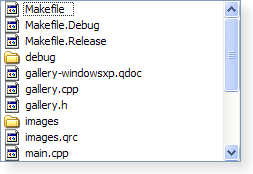
|
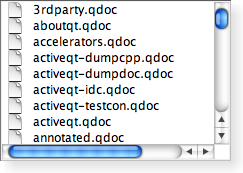
|
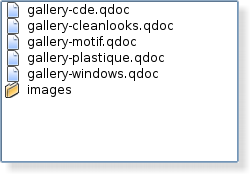
|
| A Windows XP style list 小部件。 | A Macintosh style list 小部件。 | A Plastique style list 小部件。 |
parent argument, if not None, causes self to be owned by Qt instead of PyQt.
构造空 QListWidget with the given parent .
aitem argument has it's ownership transferred to Qt.
Inserts an item with the text label at the end of the list widget.
插入 item at the end of the list widget.
警告: A QListWidgetItem can only be added to a QListWidget once. Adding the same QListWidgetItem multiple times 到 QListWidget will result in undefined behavior.
另请参阅 insertItem ().
Inserts items with the text labels at the end of the list 小部件。
另请参阅 insertItems ().
This method is also a Qt slot with the C++ signature void clear() .
移除视图中的所有项和选定。
警告: 所有项会被永久删除。
Closes the persistent editor for the given item .
另请参阅 openPersistentEditor ().
返回当前项。
另请参阅 setCurrentItem ().
重实现自 QWidget.dropEvent ().
Handles data supplied by an external drag and drop operation that ended with the given action 以给定 index . Returns true if data and action 可以是 handled by the model; otherwise returns false.
另请参阅 supportedDropActions ().
开始编辑 item 若它可编辑。
重实现自 QObject.event ().
Finds items with the text that matches the string text using the given flags .
返回 QModelIndex assocated with the given item .
item argument has it's ownership transferred to Qt.
插入 item at the position in the list given by row .
另请参阅 addItem ().
Inserts an item with the text label in the list widget at the position given by row .
另请参阅 addItem ().
Inserts items from the list of labels into the list, starting at the given row .
另请参阅 insertItem () 和 addItem ().
返回项占据给定 row in the list if one has been set; otherwise returns 0.
另请参阅 row ().
返回指针指向项在坐标 p 。 coordinates are relative to the list widget's viewport() .
这是重载函数。
返回指针指向项在坐标 ( x , y ). The coordinates are relative to the list widget's viewport() .
返回指针指向 QListWidgetItem assocated with the given index .
Returns a list of pointers to the items contained in the data object. If the object was not created by a QListWidget in the same process, the list is empty.
Returns the widget displayed in the given item .
该函数在 Qt 4.1 引入。
另请参阅 setItemWidget ().
QMimeData result
Returns an object that contains a serialized description of the specified items . The format used to describe the items is obtained from the mimeTypes () 函数。
If the list of items is empty, 0 is returned instead of a serialized empty list.
Returns a list of MIME types that can be used to describe a list of listwidget items.
另请参阅 mimeData ().
Opens an editor for the given item . The editor remains open after editing.
另请参阅 closePersistentEditor ().
Removes the widget set on the given item .
该函数在 Qt 4.3 引入。
Returns the row containing the given item .
另请参阅 item ().
This method is also a Qt slot with the C++ signature void scrollToItem(const QListWidgetItem*,QAbstractItemView::ScrollHint = QAbstractItemView.EnsureVisible) .
Scrolls the view if necessary to ensure that the item is visible.
hint specifies where the item should be located after the operation.
Returns a list of all selected items in the list widget.
Sets the current item to item .
除非选定模式为 NoSelection , item is also be selected.
另请参阅 currentItem ().
Set the current item to item ,使用给定 command .
该函数在 Qt 4.4 引入。
widget argument has it's ownership transferred to Qt.
设置 widget to be displayed in the give item .
This function should only be used to display static content in the place of a list widget item. If you want to display custom dynamic content or implement a custom editor widget, use QListView 和子类 QItemDelegate 代替。
该函数在 Qt 4.1 引入。
另请参阅 itemWidget () 和 Delegate 类 .
Sorts all the items in the list widget according to the specified order .
返回由此视图所支持的掉落动作。
另请参阅 Qt.DropActions .
QListWidgetItem result
Removes and returns the item from the given row 在 list widget; otherwise returns 0.
Items removed from a list widget will not be managed by Qt, and will need to be deleted manually.
另请参阅 insertItem () 和 addItem ().
返回项所占据的视口矩形在 item .
This is the default overload of this signal.
此信号被发射每当当前项改变时。
上一 是先前有聚焦的项; current 是新的当前项。
This is the default overload of this signal.
此信号被发射每当当前项改变时。
currentRow is the row of the current item. If there is no current item, the currentRow is -1.
This is the default overload of this signal.
此信号被发射每当当前项改变时。
currentText is the text data in the current item. If there is no current item, the currentText is invalid.
This is the default overload of this signal.
此信号被发射当 item is activated. The item is activated when the user clicks or double clicks on it, depending on the system configuration. It is also activated when the user presses the activation key (on Windows and X11 this 是 返回 key, on Mac OS X it is Ctrl+0 ).
This is the default overload of this signal.
This signal is emitted whenever the data of item has 改变。
This is the default overload of this signal.
This signal is emitted with the specified item when a mouse button is clicked on an item in the widget.
另请参阅 itemPressed () 和 itemDoubleClicked ().
This is the default overload of this signal.
This signal is emitted with the specified item when a mouse button is double clicked on an item in the widget.
另请参阅 itemClicked () 和 itemPressed ().
This is the default overload of this signal.
This signal is emitted when the mouse cursor enters an item. The item is the item entered. This signal is only emitted when mouseTracking is turned on, or when a mouse button is pressed while moving into an 项。
另请参阅 QWidget.setMouseTracking ().
This is the default overload of this signal.
This signal is emitted with the specified item when a mouse button is pressed on an item in the widget.
另请参阅 itemClicked () 和 itemDoubleClicked ().
This is the default overload of this signal.
此信号被发射每当选定改变。
另请参阅 selectedItems (), QListWidgetItem.isSelected (), and currentItemChanged ().
