The QPainter class performs low-level painting on widgets and other paint devices. 更多...
Inherited by QStylePainter .
The QPainter class performs low-level painting on widgets and other paint devices.
QPainter provides highly optimized functions to do most of the drawing GUI programs require. It can draw everything from simple lines to complex shapes like pies and chords. It can also draw aligned text and pixmaps. Normally, it draws in a "natural" coordinate system, but it can also do view and world transformation. QPainter can operate on any object that inherits the QPaintDevice 类。
The common use of QPainter is inside a widget's paint event: Construct and customize (e.g. set the pen or the brush) the painter. Then draw. Remember to destroy the QPainter object after drawing. For example:
 void SimpleExampleWidget.paintEvent(QPaintEvent *)
 {
     QPainter painter(this);
     painter.setPen(Qt.blue);
     painter.setFont(QFont("Arial", 30));
     painter.drawText(rect(), Qt.AlignCenter, "Qt");
 }
The core functionality of QPainter is drawing, but the class also provide several functions that allows you to customize QPainter's settings and its rendering quality, and others that enable clipping. In addition you can control how different shapes are merged together by specifying the painter's composition 模式。
isActive () function indicates whether the painter is active. A painter is activated by the begin () function and the constructor that takes a QPaintDevice 自变量。 end () function, and the destructor, deactivates it.
连同 QPaintDevice and QPaintEngine classes, QPainter form the basis for Qt's paint system. QPainter is the class used to perform drawing operations. QPaintDevice represents a device that can be painted on using a QPainter. QPaintEngine provides the interface that the painter uses to draw onto different types of devices. If the painter is active, device () returns the paint device on which the painter paints, and paintEngine () returns the paint engine that the painter is currently operating on. For more information, see the Paint 系统 .
Sometimes it is desirable to make someone else paint on an unusual QPaintDevice . QPainter supports a static function to do this, setRedirected ().
警告: When the paintdevice is a widget, QPainter can only be used inside a paintEvent() function or in a function called by paintEvent(); that is unless the Qt.WA_PaintOutsidePaintEvent widget attribute is set. On Mac OS X and Windows, you can only paint in a paintEvent() function regardless of this attribute's setting.
There are several settings that you can customize to make QPainter draw according to your preferences:
Note that some of these settings mirror settings in some paint devices, e.g. QWidget.font (). QPainter.begin () function (or equivalently the QPainter constructor) copies these attributes from the paint device.
可以随时保存 QPainter 状态通过调用 save () function which saves all the available settings on an internal stack. The restore () 函数将它们弹回来。
QPainter 提供绘制大多数图元的函数: drawPoint (), drawPoints (), drawLine (), drawRect (), drawRoundedRect (), drawEllipse (), drawArc (), drawPie (), drawChord (), drawPolyline (), drawPolygon (), drawConvexPolygon () 和 drawCubicBezier (). The two convenience functions, drawRects () 和 drawLines (), draw the given number of rectangles or lines in the given array of QRects or QLines 使用 the current pen and brush.
QPainter 类还提供 fillRect () function which fills the given QRect ,采用给定 QBrush ,和 eraseRect () function that erases the area inside the given rectangle.
All of these functions have both integer and floating point versions.
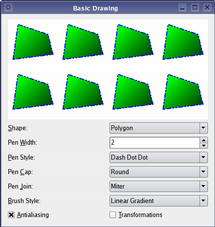
|
基本绘制范例
基本绘制 example shows how to display basic graphics primitives in a variety of styles using the QPainter class. |
If you need to draw a complex shape, especially if you need to do so repeatedly, consider creating a QPainterPath and drawing it using drawPath ().
|
描绘器路径范例
QPainterPath class provides a container for painting operations, enabling graphical shapes to be constructed and reused. Painter Paths example shows how painter paths can be used to build complex shapes 为渲染。 |
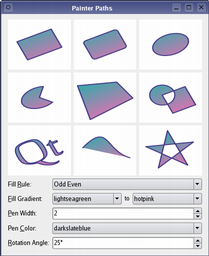
|
QPainter 还提供 fillPath () function which fills the given QPainterPath with the given QBrush ,和 strokePath () function that draws the outline of the given path (i.e. strokes the path).
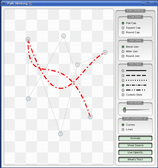
另请参阅 向量变形 demo which shows how to use advanced vector techniques to draw text 使用 QPainterPath , 渐变 demo which shows the different types of gradients that are available in Qt, and the 路径笔画 demo which shows Qt's built-in dash patterns and shows how custom patterns can be used to extend the range of available patterns.
| 向量变形 | 渐变 | 路径笔画 |
|---|---|---|
|
|
|
There are functions to draw pixmaps/images, namely drawPixmap (), drawImage () 和 drawTiledPixmap (). Both drawPixmap () 和 drawImage () produce the same result, except that drawPixmap () 是 faster on-screen while drawImage () may be faster on a QPrinter or other devices.
Text drawing is done using drawText (). When you need fine-grained positioning, boundingRect () tells you where a given drawText () command will draw.
There is a drawPicture () function that draws the contents of an entire QPicture 。 drawPicture () function is the only function that disregards all the painter's settings as QPicture has its own settings.
To get the optimal rendering result using QPainter, you should use the platform independent QImage as paint device; i.e. using QImage will ensure that the result has an identical pixel representation on any platform.
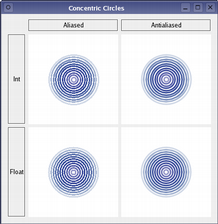
The QPainter class also provides a means of controlling the rendering quality through its RenderHint enum and the support for floating point precision: All the functions for drawing primitives has a floating point version. These are often used in combination with the QPainter.Antialiasing render hint.
|
同心圆范例
Concentric Circles example shows the improved rendering quality that can be obtained using floating point precision and anti-aliasing when drawing custom widgets. The application's main window displays several widgets which are drawn using the various combinations of precision and anti-aliasing. |
RenderHint enum specifies flags to QPainter that may or may not be respected by any given engine. QPainter.Antialiasing indicates that the engine should antialias edges of primitives if possible, QPainter.TextAntialiasing indicates that the engine should antialias text if possible, and the QPainter.SmoothPixmapTransform indicates that the engine should use a smooth pixmap transformation algorithm. HighQualityAntialiasing 是 OpenGL-specific rendering hint indicating that the engine should use fragment programs and offscreen rendering for antialiasing.
renderHints () function returns a flag that specifies the rendering hints that are set for this painter. Use the setRenderHint () function to set or clear the currently set RenderHints .
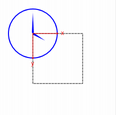
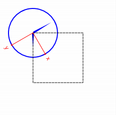
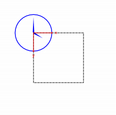
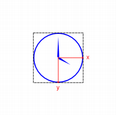
Normally, the QPainter operates on the device's own coordinate system (usually pixels), but QPainter has good support for coordinate transformations.
| nop | rotate () | scale () | translate () |
|---|---|---|---|
|
|
|
|
The most commonly used transformations are scaling, rotation, translation and shearing. Use the scale () function to scale the coordinate system by a given offset, the rotate () function to rotate it clockwise and translate () to translate it (i.e. adding a given offset to the points). You can also twist the coordinate system around the origin using the shear () function. See the 仿射变换 demo for a visualization of a sheared coordinate system.
另请参阅 变换 example which shows how transformations influence the way that QPainter renders graphics primitives. In particular it shows how the order of transformations affects the result.
|
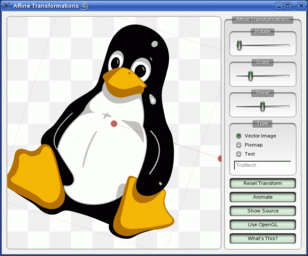
Affine Transformations Demo
仿射变换 demo show Qt's ability to perform affine transformations on painting operations. The demo also allows the user to experiment with the transformation operations and see the results immediately. |
|
All the tranformation operations operate on the transformation worldTransform (). A matrix transforms a point in the plane to another point. For more information about the transformation matrix, see the 坐标系统 and QTransform 文档编制。
setWorldTransform () function can replace or add to the currently set worldTransform ()。 resetTransform () function resets any transformations that were made using translate (), scale (), shear (), rotate (), setWorldTransform (), setViewport () 和 setWindow () functions. The deviceTransform () returns the matrix that transforms from logical coordinates to device coordinates of the platform dependent paint device. The latter function is only needed when using platform painting commands on the platform dependent handle, and the platform does not do transformations nativly.
When drawing with QPainter, we specify points using logical coordinates which then are converted into the physical coordinates of the paint device. The mapping of the logical coordinates to the physical coordinates are handled by QPainter's combinedTransform (), a combination of 视口 () 和 window () 和 worldTransform ()。 视口 () represents the physical coordinates specifying an arbitrary rectangle, the window () describes the same rectangle in logical coordinates, and the worldTransform () is identical with the transformation matrix.
另请参阅 坐标系统
QPainter can clip any drawing operation to a rectangle, a region, or a vector path. The current clip is available using the 函数 clipRegion () 和 clipPath (). Whether paths or regions are preferred (faster) depends on the underlying paintEngine (). For example, the QImage paint engine prefers paths while the X11 paint engine prefers regions. Setting a clip is done in the painters logical coordinates.
After QPainter's clipping, the paint device may also clip. For example, most widgets clip away the pixels used by child widgets, and most printers clip away an area near the edges of the paper. This additional clipping is not reflected by the return value of clipRegion () 或 hasClipping ().
QPainter 提供 CompositionMode enum which defines the Porter-Duff rules for digital image compositing; it describes a model for combining the pixels in one image, the source, with the pixels in another image, the destination.
The two most common forms of composition are Source and SourceOver . Source is used to draw opaque objects onto a paint device. In this mode, each pixel in the source replaces the corresponding pixel in the destination. In SourceOver composition mode, the source object is transparent and is drawn on top of the destination.
Note that composition transformation operates pixelwise. For that reason, there is a difference between using the graphic primitive itself and its bounding rectangle: The bounding rect contains pixels with alpha == 0 (i.e the pixels surrounding the primitive). These pixels will overwrite the other image's pixels, affectively clearing those, while the primitive only overwrites its own area.
|
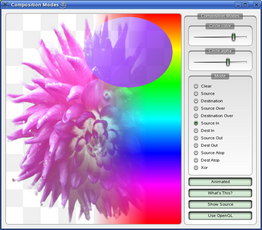
Composition Modes Demo
复合模式 demo, available in Qt's demo directory, allows you to experiment with the various composition modes and see the results immediately. |
If you are using coordinates with Qt's raster-based paint engine, it is important to note that, while coordinates greater than +/- 2 15 can be used, any painting performed with coordinates outside this range is not guaranteed to be shown; the drawing may be clipped. This is due to the use of short int in the implementation.
The outlines generated by Qt's stroker are only an approximation when dealing with curved shapes. It is in most cases impossible to represent the outline of a bezier curve segment using another bezier curve segment, and so Qt approximates the curve outlines by using several smaller curves. For performance reasons there is a limit to how many curves Qt uses for these outlines, and thus when using large pen widths or scales the outline error increases. To generate outlines with smaller errors it is possible to use the QPainterPathStroker class, which has the setCurveThreshold member function which let's the user specify the error tolerance. Another workaround is to convert the paths to polygons first and then draw the polygons instead.
QPainter is a rich framework that allows developers to do a great variety of graphical operations, such as gradients, composition modes and vector graphics. And QPainter can do this across a variety of different hardware and software stacks. Naturally the underlying combination of hardware and software has some implications for performance, and ensuring that every single operation is fast in combination with all the various combinations of composition modes, brushes, clipping, transformation, etc, is close to an impossible task because of the number of permutations. As a compromise we have selected a subset of the QPainter API and backends, where performance is guaranteed to be as good as we can sensibly get it for the given combination of hardware and software.
The backends we focus on as high-performance engines are:
These operations are:
This list gives an indication of which features to safely use in an application where performance is critical. For certain setups, other operations may be fast too, but before making extensive use of them, it is recommended to benchmark and verify them on the system where the software will run in the end. There are also cases where expensive operations are ok to use, for instance when the result is cached in a QPixmap .
Defines the modes supported for digital image compositing. Composition modes are used to specify how the pixels in one image, the source, are merged with the pixel in another image, the destination.
Please note that the bitwise raster operation modes, denoted with a RasterOp prefix, are only natively supported in the X11 and raster paint engines. This means that the only way to utilize these modes on the Mac is via a QImage 。 RasterOp denoted blend modes are not supported for pens and brushes with alpha components. Also, turning on the QPainter.Antialiasing render hint will effectively disable the RasterOp modes.
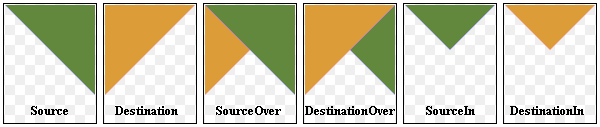
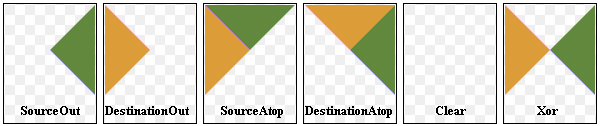
The most common type is SourceOver (often referred to as just alpha blending) where the source pixel is blended on top of the destination pixel in such a way that the alpha component of the source defines the translucency of the pixel.
When the paint device is a QImage , image format must be set to Format_ARGB32Premultiplied or Format_ARGB32 为 composition modes to have any effect. For performance the premultiplied version is the preferred format.
When a composition mode is set it applies to all painting operator, pens, brushes, gradients and pixmap/image drawing.
| 常量 | 值 | 描述 |
|---|---|---|
| QPainter.CompositionMode_SourceOver | 0 | This is the default mode. The alpha of the source is used to blend the pixel on top of the destination. |
| QPainter.CompositionMode_DestinationOver | 1 | The alpha of the destination is used to blend it on top of the source pixels. This mode is the inverse of CompositionMode_SourceOver. |
| QPainter.CompositionMode_Clear | 2 | The pixels in the destination are cleared (set to fully transparent) independent of the source. |
| QPainter.CompositionMode_Source | 3 | The output is the source pixel. (This means a basic copy operation and is identical to SourceOver when the source pixel is opaque). |
| QPainter.CompositionMode_Destination | 4 | The output is the destination pixel. This means that the blending has no effect. This mode is the inverse of CompositionMode_Source. |
| QPainter.CompositionMode_SourceIn | 5 | The output is the source, where the alpha is reduced by that of the destination. |
| QPainter.CompositionMode_DestinationIn | 6 | The output is the destination, where the alpha is reduced by that of the source. This mode is the inverse of CompositionMode_SourceIn. |
| QPainter.CompositionMode_SourceOut | 7 | The output is the source, where the alpha is reduced by the inverse of destination. |
| QPainter.CompositionMode_DestinationOut | 8 | The output is the destination, where the alpha is reduced by the inverse of the source. This mode is the inverse of CompositionMode_SourceOut. |
| QPainter.CompositionMode_SourceAtop | 9 | The source pixel is blended on top of the destination, with the alpha of the source pixel reduced by the alpha of the destination pixel. |
| QPainter.CompositionMode_DestinationAtop | 10 | The destination pixel is blended on top of the source, with the alpha of the destination pixel is reduced by the alpha of the destination pixel. This mode is the inverse of CompositionMode_SourceAtop. |
| QPainter.CompositionMode_Xor | 11 | The source, whose alpha is reduced with the inverse of the destination alpha, is merged with the destination, whose alpha is reduced by the inverse of the source alpha. CompositionMode_Xor is not the same as the bitwise Xor. |
| QPainter.CompositionMode_Plus | 12 | Both the alpha and color of the source and destination pixels are added together. |
| QPainter.CompositionMode_Multiply | 13 | The output is the source color multiplied by the destination. Multiplying a color with white leaves the color unchanged, while multiplying a color with black produces black. |
| QPainter.CompositionMode_Screen | 14 | The source and destination colors are inverted and then multiplied. Screening a color with white produces white, whereas screening a color with black leaves the color unchanged. |
| QPainter.CompositionMode_Overlay | 15 | Multiplies or screens the colors depending on the destination color. The destination color is mixed with the source color to reflect the lightness or darkness of the destination. |
| QPainter.CompositionMode_Darken | 16 | The darker of the source and destination colors is selected. |
| QPainter.CompositionMode_Lighten | 17 | The lighter of the source and destination colors is selected. |
| QPainter.CompositionMode_ColorDodge | 18 | The destination color is brightened to reflect the source color. A black source color leaves the destination color unchanged. |
| QPainter.CompositionMode_ColorBurn | 19 | The destination color is darkened to reflect the source color. A white source color leaves the destination color unchanged. |
| QPainter.CompositionMode_HardLight | 20 | Multiplies or screens the colors depending on the source color. A light source color will lighten the destination color, whereas a dark source color will darken the destination color. |
| QPainter.CompositionMode_SoftLight | 21 | Darkens or lightens the colors depending on the source color. Similar to CompositionMode_HardLight. |
| QPainter.CompositionMode_Difference | 22 | Subtracts the darker of the colors from the lighter. Painting with white inverts the destination color, whereas painting with black leaves the destination color unchanged. |
| QPainter.CompositionMode_Exclusion | 23 | Similar to CompositionMode_Difference, but with a lower contrast. Painting with white inverts the destination color, whereas painting with black leaves the destination color unchanged. |
| QPainter.RasterOp_SourceOrDestination | 24 | Does a bitwise OR operation on the source and destination pixels (src OR dst). |
| QPainter.RasterOp_SourceAndDestination | 25 | Does a bitwise AND operation on the source and destination pixels (src AND dst). |
| QPainter.RasterOp_SourceXorDestination | 26 | Does a bitwise XOR operation on the source and destination pixels (src XOR dst). |
| QPainter.RasterOp_NotSourceAndNotDestination | 27 | Does a bitwise NOR operation on the source and destination pixels ((NOT src) AND (NOT dst)). |
| QPainter.RasterOp_NotSourceOrNotDestination | 28 | Does a bitwise NAND operation on the source and destination pixels ((NOT src) OR (NOT dst)). |
| QPainter.RasterOp_NotSourceXorDestination | 29 | Does a bitwise operation where the source pixels are inverted and then XOR'ed with the destination ((NOT src) XOR dst). |
| QPainter.RasterOp_NotSource | 30 | Does a bitwise operation where the source pixels are inverted (NOT src). |
| QPainter.RasterOp_NotSourceAndDestination | 31 | Does a bitwise operation where the source is inverted and then AND'ed with the destination ((NOT src) AND dst). |
| QPainter.RasterOp_SourceAndNotDestination | 32 | Does a bitwise operation where the source is AND'ed with the inverted destination pixels (src AND (NOT dst)). |
另请参阅 compositionMode (), setCompositionMode (), 复合模式 , and Image Composition 范例 .
| 常量 | 值 | 描述 |
|---|---|---|
| QPainter.OpaqueHint | 0x01 | Indicates that the pixmap fragments to be drawn are opaque. Opaque fragments are potentially faster to draw. |
该枚举在 Qt 4.7 引入或被修改。
The PixmapFragmentHints type is a typedef for QFlags <PixmapFragmentHint>. It stores an OR combination of PixmapFragmentHint values.
另请参阅 QPainter.drawPixmapFragments () and QPainter.PixmapFragment .
Renderhints are used to specify flags to QPainter that may or may not be respected by any given engine.
| 常量 | 值 | 描述 |
|---|---|---|
| QPainter.Antialiasing | 0x01 | Indicates that the engine should antialias edges of primitives if possible. |
| QPainter.TextAntialiasing | 0x02 | Indicates that the engine should antialias text if possible. To forcibly disable antialiasing for text, do not use this hint. Instead, set QFont.NoAntialias on your font's style strategy. |
| QPainter.SmoothPixmapTransform | 0x04 | Indicates that the engine should use a smooth pixmap transformation algorithm (such as bilinear) rather than nearest neighbor. |
| QPainter.HighQualityAntialiasing | 0x08 | An OpenGL-specific rendering hint indicating that the engine should use fragment programs and offscreen rendering for antialiasing. |
| QPainter.NonCosmeticDefaultPen | 0x10 | The engine should interpret pens with a width of 0 (which otherwise enables QPen.isCosmetic ()) as being a non-cosmetic pen with a width of 1. |
The RenderHints type is a typedef for QFlags <RenderHint>. It stores an OR combination of RenderHint values.
另请参阅 renderHints (), setRenderHint (), 渲染品质 ,和 Concentric Circles 范例 .
构造描绘器。
Constructs a painter that begins painting the paint device immediately.
This constructor is convenient for short-lived painters, e.g. in a QWidget.paintEvent () 和 should be used only once. The constructor calls begin () for you and the QPainter destructor automatically calls end ().
Here's an example using begin () 和 end ():
 void MyWidget.paintEvent(QPaintEvent *)
 {
     QPainter p;
     p.begin(this);
     p.drawLine(...);        // drawing code
     p.end();
 }
The same example using this constructor:
 void MyWidget.paintEvent(QPaintEvent *)
 {
     QPainter p(this);
     p.drawLine(...);        // drawing code
 }
Since the constructor cannot provide feedback when the initialization of the painter failed you should rather use begin () 和 end () to paint on external devices, e.g. printers.
返回当前背景笔刷。
另请参阅 setBackground () 和 设置 .
返回当前背景模式。
另请参阅 setBackgroundMode () 和 设置 .
Begins painting the paint device and returns true if successful; otherwise returns false.
Notice that all painter settings ( setPen (), setBrush () etc.) are reset to default values when begin() is called.
The errors that can occur are serious problems, such as these:
 painter->begin(0); // impossible - paint device cannot be 0
 QPixmap image(0, 0);
 painter->begin(&image); // impossible - image.isNull() == true;
 painter->begin(myWidget);
 painter2->begin(myWidget); // impossible - only one painter at a time
Note that most of the time, you can use one of the constructors instead of begin(), and that end () is automatically done at destruction.
警告: A paint device can only be painted by one painter at a time.
警告: Painting on a QImage with the format QImage.Format_Indexed8 不是 supported.
Flushes the painting pipeline and prepares for the user issuing commands directly to the underlying graphics context. Must be followed by a call to endNativePainting ().
Note that only the states the underlying paint engine changes will be reset to their respective default states. The states we reset may change from release to release. The following states are currently reset in the OpenGL 2 engine:
If, for example, the OpenGL polygon mode is changed by the user inside a beginNativePaint()/ endNativePainting () block, it will not be reset to the default state by endNativePainting (). Here is an example that shows intermixing of painter commands and raw OpenGL commands:
 QPainter painter(this);
 painter.fillRect(0, 0, 128, 128, Qt.green);
 painter.beginNativePainting();
 glEnable(GL_SCISSOR_TEST);
 glScissor(0, 0, 64, 64);
 glClearColor(1, 0, 0, 1);
 glClear(GL_COLOR_BUFFER_BIT);
 glDisable(GL_SCISSOR_TEST);
 painter.endNativePainting();
该函数在 Qt 4.6 引入。
另请参阅 endNativePainting ().
Returns the bounding rectangle of the text as it will appear when drawn inside the given rectangle 采用 specified flags using the currently set font (); i.e the function tells you where the drawText () function will draw when given the same arguments.
若 text does not fit within the given rectangle 使用指定 flags , the function returns the required rectangle.
flags argument is a bitwise OR of the following flags:
If several of the horizontal or several of the vertical alignment flags are set, the resulting alignment is undefined.
另请参阅 drawText (), Qt.Alignment ,和 Qt.TextFlag .
这是重载函数。
Returns the bounding rectangle of the text as it will appear when drawn inside the given rectangle 采用 specified flags using the currently set font ().
Returns the painter's current brush.
另请参阅 QPainter.setBrush () 和 设置 .
Returns the currently set brush origin.
另请参阅 setBrushOrigin () 和 设置 .
Returns the bounding rectangle of the current clip if there is a clip; otherwise returns an empty rectangle. Note that the clip region is given in logical coordinates.
The bounding rectangle is not guaranteed to be tight.
该函数在 Qt 4.8 引入。
另请参阅 setClipRect (), setClipPath (),和 setClipRegion ().
Returns the currently clip as a path. Note that the clip path is given in logical coordinates.
警告: QPainter does not store the combined clip explicitly as this is handled by the underlying QPaintEngine , so the path is recreated on demand and transformed to the current logical coordinate system. This is potentially an expensive operation.
另请参阅 setClipPath (), clipRegion (),和 setClipping ().
Returns the currently set clip region. Note that the clip region is given in logical coordinates.
警告: QPainter does not store the combined clip explicitly as this is handled by the underlying QPaintEngine , so the path is recreated on demand and transformed to the current logical coordinate system. This is potentially an expensive operation.
另请参阅 setClipRegion (), clipPath (),和 setClipping ().
Returns the transformation matrix combining the current window/viewport and world transformation.
另请参阅 setWorldTransform (), setWindow (),和 setViewport ().
Returns the current composition mode.
另请参阅 CompositionMode and setCompositionMode ().
Returns the paint device on which this painter is currently painting, or 0 if the painter is not active.
另请参阅 isActive ().
Returns the matrix that transforms from logical coordinates to device coordinates of the platform dependent paint device.
此函数是 only needed when using platform painting commands on the platform dependent handle ( Qt.HANDLE ), and the platform does not do transformations nativly.
QPaintEngine.PaintEngineFeature enum can be queried to determine whether the platform performs the transformations or not.
另请参阅 worldTransform () 和 QPaintEngine.hasFeature ().
Draws the arc defined by the given rectangle , startAngle and spanAngle .
startAngle and spanAngle must be specified in 1/16th of a degree, i.e. a full circle equals 5760 (16 * 360). Positive values for the angles mean counter-clockwise while negative values mean the clockwise direction. Zero degrees is at the 3 o'clock position.

|
QRectF rectangle(10.0, 20.0, 80.0, 60.0); int startAngle = 30 * 16; int spanAngle = 120 * 16; QPainter painter(this); painter.drawArc(rectangle, startAngle, spanAngle); |
另请参阅 drawPie (), drawChord (),和 坐标系统 .
这是重载函数。
Draws the arc defined by the given rectangle , startAngle and spanAngle .
这是重载函数。
Draws the arc defined by the rectangle beginning at ( x , y ) with the specified width and height ,和 the given startAngle and spanAngle .
Draws the chord defined by the given rectangle , startAngle and spanAngle . The chord is filled with the current brush ().
The startAngle and spanAngle must be specified in 1/16th of a degree, i.e. a full circle equals 5760 (16 * 360). Positive values for the angles mean counter-clockwise while negative values mean the clockwise direction. Zero degrees is at the 3 o'clock position.

|
QRectF rectangle(10.0, 20.0, 80.0, 60.0); int startAngle = 30 * 16; int spanAngle = 120 * 16; QPainter painter(this); painter.drawChord(rect, startAngle, spanAngle); |
另请参阅 drawArc (), drawPie (),和 坐标系统 .
这是重载函数。
Draws the chord defined by the given rectangle , startAngle and spanAngle .
这是重载函数。
Draws the chord defined by the rectangle beginning at ( x , y ) with the specified width and height ,和 the given startAngle and spanAngle .
Draws the convex polygon defined by the first pointCount points in the array points using the current pen.

|
static const QPointF points[4] = { QPointF(10.0, 80.0), QPointF(20.0, 10.0), QPointF(80.0, 30.0), QPointF(90.0, 70.0) }; QPainter painter(this); painter.drawConvexPolygon(points, 4); |
The first point is implicitly connected to the last point, and the polygon is filled with the current brush (). If the supplied polygon is not convex, i.e. it contains at least one angle larger than 180 degrees, the results are undefined.
On some platforms (e.g. X11), the drawConvexPolygon() function can be faster than the drawPolygon () 函数。
另请参阅 drawPolygon (), drawPolyline (),和 坐标系统 .
这是重载函数。
Draws the convex polygon defined by the first pointCount points in the array points using the current pen.
这是重载函数。
Draws the convex polygon defined by polygon 使用 current pen and brush.
这是重载函数。
Draws the convex polygon defined by polygon 使用 current pen and brush.
Draws the ellipse defined by the given rectangle .
A filled ellipse has a size of rectangle . size() . A stroked ellipse has a size of rectangle . size() plus the pen width.

|
QRectF rectangle(10.0, 20.0, 80.0, 60.0); QPainter painter(this); painter.drawEllipse(rectangle); |
这是重载函数。
Draws the ellipse defined by the given rectangle .
这是重载函数。
Draws the ellipse defined by the rectangle beginning at ( x , y ) with the given width and height .
这是重载函数。
Draws the ellipse positioned at center with radii rx and ry .
该函数在 Qt 4.4 引入。
这是重载函数。
Draws the ellipse positioned at center with radii rx and ry .
该函数在 Qt 4.4 引入。
Draws the specified glyphs at the given position . position gives the edge of the baseline for the string of glyphs. The glyphs will be retrieved from the font selected by glyphs and at offsets given by the positions in glyphs .
该函数在 Qt 4.8 引入。
另请参阅 QGlyphRun.setRawFont (), QGlyphRun.setPositions (),和 QGlyphRun.setGlyphIndexes ().
Draws the rectangular portion source of the given image into the target rectangle in the paint 设备。
注意: The image is scaled to fit the rectangle, if both the image and rectangle size disagree.
If the image needs to be modified to fit in a lower-resolution result (e.g. converting from 32-bit to 8-bit), use the flags to specify how you would prefer this to happen.
QRectF target(10.0, 20.0, 80.0, 60.0); QRectF source(0.0, 0.0, 70.0, 40.0); QImage image(":/images/myImage.png"); QPainter painter(this); painter.drawImage(target, image, source); |
另请参阅 drawPixmap ().
这是重载函数。
Draws the rectangular portion source of the given image into the target rectangle in the paint 设备。
注意: The image is scaled to fit the rectangle, if both the image and rectangle size disagree.
这是重载函数。
绘制给定 image at the given point .
这是重载函数。
绘制给定 image at the given point .
这是重载函数。
Draws the rectangular portion source of the given image with its origin at the given point .
这是重载函数。
Draws the rectangular portion source of the given image with its origin at the given point .
这是重载函数。
绘制给定 image 进给定 rectangle .
注意: The image is scaled to fit the rectangle, if both the image and rectangle size disagree.
这是重载函数。
绘制给定 image 进给定 rectangle .
注意: The image is scaled to fit the rectangle, if both the image and rectangle size disagree.
这是重载函数。
Draws an image at ( x , y ) by copying a part of image into the paint device.
( x , y ) specifies the top-left point in the paint device that is to be drawn onto. ( sx , sy ) specifies the top-left point in image that is to be drawn. The default is (0, 0).
( sw , sh ) specifies the size of the image that is to be drawn. The default, (0, 0) (and negative) means all the way to the bottom-right of the image.
Draws a line defined by line .

|
QLineF line(10.0, 80.0, 90.0, 20.0); QPainter(this); painter.drawLine(line); |
另请参阅 drawLines (), drawPolyline (),和 坐标系统 .
这是重载函数。
Draws a line defined by line .
这是重载函数。
Draws a line from p1 to p2 .
这是重载函数。
Draws a line from p1 to p2 .
这是重载函数。
Draws a line from ( x1 , y1 ) to ( x2 , y2 ) and sets the current pen position to ( x2 , y2 ).
Draws the first lineCount lines in the array lines using the current pen.
另请参阅 drawLine () and drawPolyline ().
这是重载函数。
Draws the first lineCount lines in the array lines using the current pen.
这是重载函数。
Draws the first lineCount lines in the array pointPairs using the current pen. The lines are specified as pairs of points so the number of entries in pointPairs must be at least lineCount * 2.
这是重载函数。
Draws the first lineCount lines in the array pointPairs using the current pen.
这是重载函数。
Draws a line for each pair of points in the vector pointPairs using the current pen. If there is an odd number of points in the array, the last point will be ignored.
这是重载函数。
Draws a line for each pair of points in the vector pointPairs using the current pen.
这是重载函数。
Draws the set of lines defined by the list lines 使用 the current pen and brush.
这是重载函数。
Draws the set of lines defined by the list lines 使用 the current pen and brush.
Draws the given painter path using the current pen for outline and the current brush for filling.

|
QPainterPath path; path.moveTo(20, 80); path.lineTo(20, 30); path.cubicTo(80, 0, 50, 50, 80, 80); QPainter painter(this); painter.drawPath(path); |
另请参阅 the Painter Paths example and the Vector Deformation demo .
Replays the given picture at the given point .
QPicture class is a paint device that records and replays QPainter commands. A picture serializes the painter commands to an IO device in a platform-independent format. Everything that can be painted on a widget or pixmap can also be stored in a picture.
This function does exactly the same as QPicture.play () when called with point = QPoint (0, 0).
QPicture picture; QPointF point(10.0, 20.0) picture.load("drawing.pic"); QPainter painter(this); painter.drawPicture(0, 0, picture); |
另请参阅 QPicture.play ().
这是重载函数。
Replays the given picture at the given point .
这是重载函数。
绘制给定 picture at point ( x , y ).
Draws a pie defined by the given rectangle , startAngle and and spanAngle .
The pie is filled with the current brush ().
The startAngle and spanAngle must be specified in 1/16th of a degree, i.e. a full circle equals 5760 (16 * 360). Positive values for the angles mean counter-clockwise while negative values mean the clockwise direction. Zero degrees is at the 3 o'clock position.

|
QRectF rectangle(10.0, 20.0, 80.0, 60.0); int startAngle = 30 * 16; int spanAngle = 120 * 16; QPainter painter(this); painter.drawPie(rectangle, startAngle, spanAngle); |
另请参阅 drawEllipse (), drawChord (),和 坐标系统 .
这是重载函数。
Draws a pie defined by the given rectangle , startAngle and and spanAngle .
这是重载函数。
Draws the pie defined by the rectangle beginning at ( x , y ) with the specified width and height ,和 the given startAngle and spanAngle .
Draws the rectangular portion source of the given pixmap 进给定 target in the paint device.
注意: The pixmap is scaled to fit the rectangle, if both the pixmap and rectangle size disagree.
QRectF target(10.0, 20.0, 80.0, 60.0); QRectF source(0.0, 0.0, 70.0, 40.0); QPixmap pixmap(":myPixmap.png"); QPainter(this); painter.drawPixmap(target, image, source); |
若 pixmap 是 QBitmap it is drawn with the bits that are "set" using the pens color. If backgroundMode is Qt.OpaqueMode , the "unset" bits are drawn using the color of the background brush; if backgroundMode is Qt.TransparentMode , the "unset" bits are transparent. Drawing bitmaps with gradient or texture colors is not supported.
另请参阅 drawImage ().
这是重载函数。
Draws the rectangular portion source of the given pixmap 进给定 target in the paint device.
注意: The pixmap is scaled to fit the rectangle, if both the pixmap and rectangle size disagree.
这是重载函数。
Draws the rectangular portion source of the given pixmap with its origin at the given point .
这是重载函数。
Draws the rectangular portion source of the given pixmap with its origin at the given point .
这是重载函数。
绘制给定 pixmap with its origin at the given point .
这是重载函数。
绘制给定 pixmap with its origin at the given point .
这是重载函数。
绘制给定 pixmap at position ( x , y ).
这是重载函数。
绘制给定 pixmap 进给定 rectangle .
注意: The pixmap is scaled to fit the rectangle, if both the pixmap and rectangle size disagree.
这是重载函数。
Draws the pixmap into the rectangle at position ( x , y ) with the given width and height .
这是重载函数。
Draws the rectangular portion with the origin ( sx , sy ), width sw and height sh , of the given pixmap , at the point ( x , y ), with a width of w and a height of h . If sw or sh are equal to zero the width/height of the pixmap is used and adjusted by the offset sx/sy;
这是重载函数。
Draws a pixmap at ( x , y ) by copying a part of the given pixmap into the paint device.
( x , y ) specifies the top-left point in the paint device that is to be drawn onto. ( sx , sy ) specifies the top-left point in pixmap that is to be drawn. The default is (0, 0).
( sw , sh ) specifies the size of the pixmap that is to be drawn. The default, (0, 0) (and negative) means all the way to the bottom-right of the pixmap.
This function is used to draw pixmap , or a sub-rectangle of pixmap , at multiple positions with different scale, rotation and opacity. fragments is an array of fragmentCount elements specifying the parameters used to draw each pixmap fragment. The hints parameter can be used to pass in drawing hints.
This function is potentially faster than multiple calls to drawPixmap (), since the backend can optimize state changes.
该函数在 Qt 4.7 引入。
另请参阅 QPainter.PixmapFragment and QPainter.PixmapFragmentHint .
sourceRects argument may also be None.
This function is used to draw the same pixmap with multiple target and source rectangles specified by targetRects 。若 sourceRects is 0, the whole pixmap will be rendered at each of the target rectangles. The hints parameter can be used to pass in drawing hints.
This function is potentially faster than multiple calls to drawPixmap (), since the backend can optimize state changes.
该函数在 Qt 4.8 引入。
另请参阅 QPainter.PixmapFragmentHint .
Draws a single point at the given position 使用 current pen's color.
另请参阅 Coordinate 系统 .
这是重载函数。
Draws a single point at the given position 使用 current pen's color.
这是重载函数。
Draws a single point at position ( x , y ).
Draws the first pointCount points in the array points using the current pen's color.
另请参阅 Coordinate 系统 .
这是重载函数。
Draws the first pointCount points in the array points using the current pen's color.
这是重载函数。
Draws the points in the vector points .
这是重载函数。
Draws the points in the vector points .
Draws the polygon defined by the first pointCount points in the array points 使用当前钢笔和笔刷。
|
|
static const QPointF points[4] = { QPointF(10.0, 80.0), QPointF(20.0, 10.0), QPointF(80.0, 30.0), QPointF(90.0, 70.0) }; QPainter painter(this); painter.drawPolygon(points, 4); |
The first point is implicitly connected to the last point, and the polygon is filled with the current brush ().
若 fillRule is Qt.WindingFill , the polygon is filled using the winding fill algorithm. If fillRule is Qt.OddEvenFill , the polygon is filled using the odd-even fill algorithm. See Qt.FillRule for a more detailed description of these fill rules.
另请参阅 drawConvexPolygon (), drawPolyline (),和 坐标系统 .
这是重载函数。
Draws the polygon defined by the first pointCount points in the array points .
Draws the polyline defined by the first pointCount points in points using the current pen.
Note that unlike the drawPolygon () function the last point is not connected to the first, neither is the polyline filled.
static const QPointF points[3] = { QPointF(10.0, 80.0), QPointF(20.0, 10.0), QPointF(80.0, 30.0), }; QPainter painter(this); painter.drawPolyline(points, 3); |
另请参阅 drawLines (), drawPolygon (),和 坐标系统 .
这是重载函数。
Draws the polyline defined by the first pointCount points in points using the current pen.
这是重载函数。
Draws the polyline defined by the given points 使用 current pen.
Draws the current rectangle with the current pen and brush.
A filled rectangle has a size of rectangle .size(). A stroked rectangle has a size of rectangle .size() plus the pen width.

|
QRectF rectangle(10.0, 20.0, 80.0, 60.0); QPainter painter(this); painter.drawRect(rectangle); |
另请参阅 drawRects (), drawPolygon (),和 坐标系统 .
这是重载函数。
Draws the current rectangle with the current pen and brush.
这是重载函数。
Draws a rectangle with upper left corner at ( x , y ) and with the given width and height .
Draws the first rectCount of the given rectangles 使用当前钢笔和笔刷。
另请参阅 drawRect ().
这是重载函数。
Draws the first rectCount of the given rectangles 使用当前钢笔和笔刷。
这是重载函数。
绘制给定 rectangles using the current pen and brush.
这是重载函数。
绘制给定 rectangles using the current pen and brush.
Draws the given rectangle rect with rounded corners.
xRadius and yRadius arguments specify the radii of the ellipses defining the corners of the rounded rectangle. When mode is Qt.RelativeSize , xRadius and yRadius are specified in percentage of half the rectangle's width and height respectively, and should be in the range 0.0 to 100.0.
A filled rectangle has a size of rect.size(). A stroked rectangle has a size of rect.size() plus the pen width.

|
QRectF rectangle(10.0, 20.0, 80.0, 60.0); QPainter painter(this); painter.drawRoundedRect(rectangle, 20.0, 15.0); |
该函数在 Qt 4.4 引入。
这是重载函数。
Draws the given rectangle rect with rounded corners.
该函数在 Qt 4.4 引入。
这是重载函数。
Draws the given rectangle x , y , w , h with rounded corners.
该函数在 Qt 4.4 引入。
绘制给定 staticText at the given topLeftPosition .
The text will be drawn using the font and the transformation set on the painter. If the font and/or transformation set on the painter are different from the ones used to initialize the layout 的 QStaticText , then the layout will have to be recalculated. Use QStaticText.prepare () to initialize staticText with the font and transformation with which it will later be drawn.
若 topLeftPosition is not the same as when staticText was initialized, or when it was last drawn, then there will be a slight overhead when translating the text to its new position.
注意: If the painter's transformation is not affine, then staticText will be drawn using regular calls to drawText (), losing any potential for performance improvement.
注意: The y-position is used as the top of the font.
该函数在 Qt 4.7 引入。
另请参阅 QStaticText .
这是重载函数。
Draws the staticText 在 topLeftPosition .
注意: The y-position is used as the top of the font.
该函数在 Qt 4.7 引入。
这是重载函数。
Draws the staticText at coordinates left and top .
注意: The y-position is used as the top of the font.
该函数在 Qt 4.7 引入。
绘制给定 text with the currently defined text direction, beginning at the given position .
This function does not handle the newline character (\n), as it cannot break text into multiple lines, and it cannot display the newline character. Use the QPainter.drawText() overload that takes a rectangle instead if you want to draw multiple lines of text with the newline character, or if you want the text to be wrapped.
默认情况下, QPainter draws text anti-aliased.
注意: The y-position is used as the baseline of the font.
Draws a tiled pixmap , inside the given rectangle with its origin at the given position .
调用 drawTiledPixmap() 类似调用 drawPixmap () several times to fill (tile) an area with a pixmap, but is potentially much more efficient depending on the underlying window system.
另请参阅 drawPixmap ().
这是重载函数。
Draws a tiled pixmap , inside the given rectangle with its origin at the given position .
这是重载函数。
Draws a tiled pixmap in the specified rectangle.
( x , y ) specifies the top-left point in the paint device that is to be drawn onto; with the given width and height . ( sx , sy ) specifies the top-left point 在 pixmap that is to be drawn; this defaults to (0, 0).
Ends painting. Any resources used while painting are released. You don't normally need to call this since it is called by the 析构函数。
Returns true if the painter is no longer active; otherwise returns false.
Restores the painter after manually issuing native painting commands. Lets the painter restore any native state that it relies on before calling any other painter commands.
该函数在 Qt 4.6 引入。
另请参阅 beginNativePainting ().
Erases the area inside the given rectangle . Equivalent to calling
fillRect(rectangle, background()).
另请参阅 fillRect ().
这是重载函数。
Erases the area inside the given rectangle .
这是重载函数。
Erases the area inside the rectangle beginning at ( x , y ) with the given width and height .
Fills the given path using the given brush 。 outline is not drawn.
Alternatively, you can specify a QColor 而不是 QBrush ; the QBrush constructor (taking a QColor argument) will automatically create a solid pattern brush.
另请参阅 drawPath ().
Fills the given rectangle 采用 brush 指定。
Alternatively, you can specify a QColor 而不是 QBrush ; the QBrush constructor (taking a QColor argument) will automatically create a solid pattern brush.
另请参阅 drawRect ().
这是重载函数。
Fills the rectangle beginning at ( x , y ) with the given width and height , using the brush style 指定。
该函数在 Qt 4.5 引入。
这是重载函数。
Fills the given rectangle with the brush style 指定。
该函数在 Qt 4.5 引入。
这是重载函数。
Fills the given rectangle with the brush style 指定。
该函数在 Qt 4.5 引入。
这是重载函数。
Fills the given rectangle with the specified brush .
这是重载函数。
Fills the given rectangle 采用 color 指定。
该函数在 Qt 4.5 引入。
这是重载函数。
Fills the given rectangle 采用 color 指定。
该函数在 Qt 4.5 引入。
这是重载函数。
Fills the rectangle beginning at ( x , y ) with the given width and height ,使用给定 brush .
这是重载函数。
Fills the rectangle beginning at ( x , y ) with the given width and height ,使用给定 color .
该函数在 Qt 4.5 引入。
这是重载函数。
Fills the rectangle beginning at ( x , y ) with the given width and height ,使用给定 color .
该函数在 Qt 4.5 引入。
这是重载函数。
Fills the given rectangle with the specified color .
该函数在 Qt 4.5 引入。
这是重载函数。
Fills the given rectangle with the specified color .
该函数在 Qt 4.5 引入。
Returns the currently set font used for drawing text.
另请参阅 setFont (), drawText (),和 设置 .
Returns the font info for the painter if the painter is active. Otherwise, the return value is undefined.
另请参阅 font (), isActive (),和 设置 .
Returns the font metrics for the painter if the painter is active. Otherwise, the return value is undefined.
另请参阅 font (), isActive (),和 设置 .
Returns true if clipping has been set; otherwise returns false.
另请参阅 setClipping () 和 Clipping .
Initializes the painters pen, background and font to the same as the given widget . This function is called automatically when the painter is opened on a QWidget .
返回 true 若 begin () has been called and end () has not yet been called; otherwise returns false.
另请参阅 begin () 和 QPaintDevice.paintingActive ().
Returns the layout direction used by the painter when drawing text.
另请参阅 QTextOption.textDirection (), setLayoutDirection (), drawText (),和 设置 .
返回描绘器的不透明度。默认值为 1。
该函数在 Qt 4.2 引入。
另请参阅 setOpacity ().
Returns the paint engine that the painter is currently operating on if the painter is active; otherwise 0.
另请参阅 isActive ().
返回描绘器的当前钢笔。
Returns a flag that specifies the rendering hints that are set for this painter.
另请参阅 setRenderHints (), testRenderHint (),和 渲染品质 .
Resets any transformations that were made using translate (), scale (), shear (), rotate (), setWorldTransform (), setViewport () 和 setWindow ().
另请参阅 Coordinate 变换 .
Restores the current painter state (pops a saved state off the stack).
另请参阅 save ().
Rotates the coordinate system the given angle clockwise.
另请参阅 setWorldTransform () 和 Coordinate 变换 .
Saves the current painter state (pushes the state onto a stack). A save() must be followed by a corresponding restore (); the end () function unwinds the stack.
另请参阅 restore ().
Scales the coordinate system by ( sx , sy ).
另请参阅 setWorldTransform () 和 Coordinate 变换 .
将描绘器背景笔刷设为给定 brush .
The background brush is the brush that is filled in when drawing opaque text, stippled lines and bitmaps. The background brush has no effect in transparent background mode (which is the default).
另请参阅 background (), setBackgroundMode (),和 设置 .
将描绘器背景模式设为给定 mode
Qt.TransparentMode (the default) draws stippled lines and text without setting the background pixels. Qt.OpaqueMode 填充这些空间采用当前背景色。
Note that in order to draw a bitmap or pixmap transparently, you must use QPixmap.setMask ().
另请参阅 backgroundMode (), setBackground (),和 设置 .
把描绘器的笔刷设为给定 brush .
描绘器的笔刷定义形状如何被填充。
这是重载函数。
把描绘器的笔刷设为黑色,并指定 style .
Sets the brush origin to position .
The brush origin specifies the (0, 0) coordinate of the painter's brush.
Note that while the brushOrigin () was necessary to adopt the parent's background for a widget in Qt 3, this is no longer the case since the Qt 4 painter doesn't paint the background unless you explicitly tell it to do so by setting the widget's autoFillBackground property to true.
另请参阅 brushOrigin () 和 设置 .
这是重载函数。
Sets the brush's origin to the given position .
这是重载函数。
Sets the brush's origin to point ( x , y ).
Enables clipping, and sets the clip path for the painter to the given path , with the clip operation .
Note that the clip path is specified in logical (painter) coordinates.
另请参阅 clipPath (), clipRegion (),和 Clipping .
Enables clipping if enable is true, or disables clipping if enable is false.
另请参阅 hasClipping () 和 Clipping .
Enables clipping, and sets the clip region to the given rectangle using the given clip operation 。默认 operation is to replace the current clip rectangle.
Note that the clip rectangle is specified in logical (painter) coordinates.
另请参阅 clipRegion (), setClipping (),和 Clipping .
Enables clipping, and sets the clip region to the rectangle beginning at ( x , y ) with the given width and height .
这是重载函数。
Enables clipping, and sets the clip region to the given rectangle using the given clip operation .
Sets the clip region to the given region 使用 specified clip operation . The default clip operation is to replace the current clip region.
Note that the clip region is given in logical coordinates.
另请参阅 clipRegion (), setClipRect (),和 Clipping .
将合成模式设为给定 mode .
警告: Only a QPainter operating on a QImage fully supports all composition modes. The RasterOp modes are supported for X11 as described in compositionMode ().
另请参阅 compositionMode ().
Sets the painter's font to the given font .
This font is used by subsequent drawText () functions. The text color is the same as the pen color.
If you set a font that isn't available, Qt finds a close match. font () will return what you set using setFont() and fontInfo () returns the font actually being used (which may be the same).
另请参阅 font (), drawText (),和 设置 .
Sets the layout direction used by the painter when drawing text, 到指定 direction .
默认为 Qt.LayoutDirectionAuto , which will implicitly determine the direction from the text drawn.
另请参阅 QTextOption.setTextDirection (), layoutDirection (), drawText (),和 设置 .
把描绘器的不透明度,设为 opacity 。值 should be in the range 0.0 to 1.0, where 0.0 is fully transparent and 1.0 is fully opaque.
Opacity set on the painter will apply to all drawing operations individually.
该函数在 Qt 4.2 引入。
另请参阅 opacity ().
把描绘器的钢笔,设为给定 pen .
pen defines how to draw lines and outlines, and it also defines the text color.
这是重载函数。
Sets the painter's pen to have style Qt.SolidLine , width 0 and the specified color .
这是重载函数。
Sets the painter's pen to have the given style , width 0 and black color.
Sets the given render hint on the painter if on is true; otherwise clears the render hint.
另请参阅 setRenderHints (), renderHints (),和 渲染品质 .
Sets the given render hints on the painter if on is true; otherwise clears the render hints.
该函数在 Qt 4.2 引入。
另请参阅 setRenderHint (), renderHints (),和 渲染品质 .
Sets the world transformation matrix. If combine is true, the specified transform is combined with the current matrix; otherwise it replaces the current matrix.
该函数在 Qt 4.3 引入。
另请参阅 transform () 和 setWorldTransform ().
Sets the painter's viewport rectangle to the given rectangle , and enables view transformations.
The viewport rectangle is part of the view transformation. The viewport specifies the device coordinate system. Its sister, the window (), specifies the logical coordinate system.
The default viewport rectangle is the same as the device's rectangle.
另请参阅 视口 (), viewTransformEnabled (), and Window-Viewport Conversion .
这是重载函数。
Sets the painter's viewport rectangle to be the rectangle beginning at ( x , y ) with the given width and height .
Enables view transformations if enable is true, or disables view transformations if enable is false.
另请参阅 viewTransformEnabled () 和 Window-Viewport Conversion .
Sets the painter's window to the given rectangle ,和 enables view transformations.
The window rectangle is part of the view transformation. The window specifies the logical coordinate system. Its sister, the 视口 (), specifies the device coordinate system.
The default window rectangle is the same as the device's rectangle.
另请参阅 window (), viewTransformEnabled (), and Window-Viewport Conversion .
这是重载函数。
Sets the painter's window to the rectangle beginning at ( x , y ) and the given width and height .
Enables transformations if enable is true, or disables transformations if enable is false. The world transformation matrix is not changed.
该函数在 Qt 4.2 引入。
另请参阅 worldMatrixEnabled (), worldTransform (),和 Coordinate 变换 .
Sets the world transformation matrix. If combine is true, the specified matrix is combined with the current matrix; otherwise it replaces the current matrix.
另请参阅 worldTransform (), transform (),和 setTransform ().
Shears the coordinate system by ( sh , sv ).
另请参阅 setWorldTransform () 和 Coordinate 变换 .
Draws the outline (strokes) the path path with the pen 指定通过 pen
返回 true 若 hint is set; otherwise returns false.
该函数在 Qt 4.3 引入。
另请参阅 renderHints () 和 setRenderHint ().
Returns the world transformation matrix.
另请参阅 setTransform () 和 worldTransform ().
Translates the coordinate system by the given offset ; i.e. the given offset is added to points.
另请参阅 setWorldTransform () 和 Coordinate 变换 .
这是重载函数。
Translates the coordinate system by the given offset .
这是重载函数。
Translates the coordinate system by the vector ( dx , dy ).
Returns the viewport rectangle.
另请参阅 setViewport () 和 setViewTransformEnabled ().
Returns true if view transformation is enabled; otherwise returns false.
另请参阅 setViewTransformEnabled () and worldTransform ().
Returns the window rectangle.
另请参阅 setWindow () 和 setViewTransformEnabled ().
Returns true if world transformation is enabled; otherwise returns false.
该函数在 Qt 4.2 引入。
另请参阅 setWorldMatrixEnabled (), worldTransform (),和 坐标系统 .
Returns the world transformation matrix.
另请参阅 setWorldTransform ().
